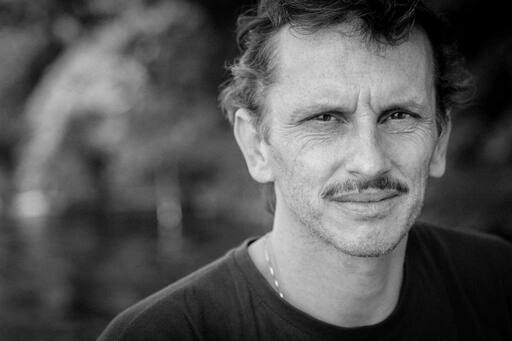
Federico Polucci
Federico Polucci, born 1976 in Rome, Italy, holds a bachelor’s degree in fashion and costume design from the European Institute of Design (I.E.D.) in Rome (1998) and a diploma in applied arts from the State Art Institute of Tivoli (1995). After gaining experience in the fashion world, from 2002 to 2008 he worked in experimental theatre, including with the »Afrodita Company« (Rome – Tel Aviv). He moved to Berlin in 2007 to work in the fields of dance theatre and visual arts.
As a freelancer, he has collaborated with, amongst others, Sergiu Matis, Gabriel Galindez Cruz, Antonio Ruz, Maria Colusi, Jirí Bartovaneć, Sasa Queliz, Martha Hincapié Cherry, Maya M. Carroll, Nagao Akemi, Niels Weijer, KNM Ensemble, Make a Move Collective as well as the Teatro Dell’Orologio and the Teatro di Tor Bella Monaca in Rome. In 2017 and 2024, he worked in the costume department at the Friedrichstadtpalast on the productions »Spiel mit der Zeit« and »Frida & Frida«, before returning to freelance work in 2025.
Since 2008, he has been working with Sasha Waltz & Guests. During this time he has designed the costumes for »for the time being« (2026), »Dialoge-Reethaus« (Reethaus in Berlin, 2026), »Freiheit/Exstasis« (the first part of »Beethoven 7«, 2023), »EΞΟΔΟΣ I EXODOS« (2018), and »Figure Humaine« (Elbphilharmonie, 2017) together with Margaretha Heller. Since 2009, he has also designed costumes for the Children’s Dance Company of Sasha Waltz & Guests with choreographers Gabriel Galindez Cruz, Alessandra Defazio and Jirí Bartovaneć.
In 2019, he began developing masks and headpieces by recycling various materials and judo belts. One of his key focusses lies in applying geometric forms to the body using lines, folds and layers, bands, ribbons and strips, patterns, transparencies and textures to support and highlight the artists’ movement. The concepts of fusing organic and sculptural elements in the creation of moving figures and the deconstruction of the garment are at the heart of his design and research. This mental constellation, understood as a challenge, must be reflected in designs that are both extreme and minimalist. The voice of the body, the story to be told, the choreographer’s vision and the messages to the audience are filtered and highlighted through the design.